Heated Driveways in Naperville, IL
Snow-melt heat under a new concrete driveway, with the slab, the joint lines, and Naperville's apron rules planned around it before anything is poured.
- Licensed & Insured
- Free On-Site Quotes
- Driveway Permits Handled
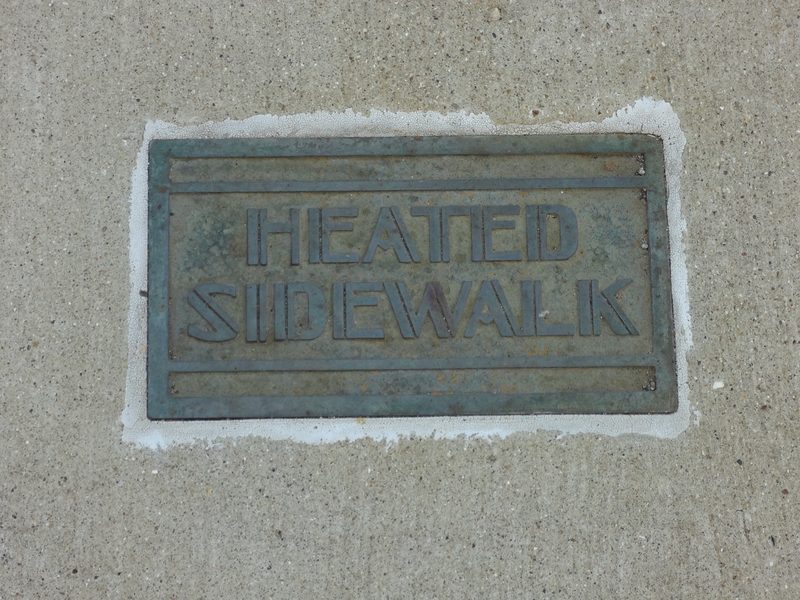
Heated concrete, marked in the slab. Photo: “Heated Sidewalk” by Paul Sableman, CC BY 2.0.
Tell us about your project
Takes about 60 seconds. We’ll get back to you within one business day to schedule a free on-site visit.
What a Heated Driveway Costs to Run in Naperville
Naperville sells its own electricity, so these numbers use the city's 2026 residential rate: 11.968 cents per kilowatt-hour, flat, with no time-of-day pricing and no seasonal pricing beyond a monthly purchased power adjustment. Aurora and Plainfield are on ComEd, which Naperville says costs more.
Electric snow melt is sized by the square foot: nVent's design table puts Chicago-area concrete at 35 watts per square foot, where colder Minneapolis gets 50. At 35 watts, an hour of run time costs:
About 42 cents an hour. That's 3.5 kilowatts, billed at the city rate.
About 75 cents an hour for four 18-inch tracks at 35 watts; nVent's tire-track cable draws about 10.4 kilowatts, closer to $1.24.
About $2.51 an hour. 21 kilowatts while it runs.
About $3.59 an hour. WarmlyYours' cable at 3-inch spacing instead of 4 runs 45 to 50 watts: faster melting, higher bill.
Over a season, ASHRAE's Chicago data puts the energy to melt a typical winter's snow at about 2.5 kilowatt-hours per square foot: about 1,500 kilowatt-hours on the 600 square foot driveway, roughly $180 at the 2026 rate. That's the floor. Add ground losses (ASHRAE's own Chicago example adds 30 percent), or run the full 21 kilowatts through a typical year's 124 hours of snowfall, and a realistic year lands closer to $230 to $310, before any run time after the snow stops.
That range assumes a snow sensor running the heat only while it snows. Idle the slab warm through every freezing hour instead, roughly 1,850 of them against those 124 hours of snow, and it uses about 14 times the energy of melting alone.
These figures leave out the purchased power adjustment and bill taxes, and the city's scheduled 2027 rate is 12.548 cents, about 5 percent more. A gas-fired hydronic system's running cost follows the gas bill instead.
Electric vs. Hydronic Snow-Melt Systems
Electric cable or mats
Resistance cable, run loose or pre-spaced on mesh mats and buried in the slab. It's the simpler system: no boiler and no fluid. Every circuit gets 30-milliamp ground-fault protection, because a damaged cable can arc without tripping a normal breaker. The trade-off is power draw.
Hydronic tubing
PEX tubing in the slab carrying warm antifreeze from a boiler, with food-grade propylene glycol the recommended mix. It trades the electric system's amperage for equipment: a boiler, a pump, and often a heat exchanger that keeps the antifreeze out of your house heat. It also wants at least 2 inches of rigid foam underneath, which Uponor's guidance makes mandatory on wet ground, and Drummer soil, common in central-south Naperville, is poorly drained, with a seasonal water table as shallow as about 6 inches.
Heating only the tire tracks
Heating just the wheel paths cuts the heated area, and the bill, to a fraction. You give up everything between and beside them, including the walk from the car to the door; if you want the whole surface clear, you heat the whole surface. And it's a concrete option only: the cable makers warn against tracks under pavers, which can sink.
How We Quote
-
01
Tell Us About Your Project
Fill out the quote form or call us. Takes about 60 seconds. We'll know enough to schedule a free on-site visit.
-
02
On-Site Quote, No Pressure
We measure, talk through the heated area and layout options, and give you a written quote. No deposit, no commitment.
-
03
Poured in Season
Once you say go, we schedule the pour.
Can Your Electrical Service Carry a Heated Driveway?
This is often the question that decides the project. At 35 watts the 600 square foot driveway draws about 88 amps at 240 volts. Snow melting counts as a continuous load, so a 40-amp circuit carries only 32 amps of it: about three 40-amp circuits, on top of everything the house already draws. The city utility's standard service for a new home is 200 amps.
Tire tracks ease the load: about 26 amps at 35 watts, inside one 40-amp circuit, or about 43 amps and two circuits with nVent's tire-track cable. Full coverage on a big driveway is where service upgrades come in, and here they go through the city's electric utility, not ComEd. Going past 200 amps is allowed with extra requirements, and if the utility's neighborhood equipment needs upgrading for your load, you pay for it. A load calculation on the house (the city publishes a worksheet) settles the panel question before anyone prices the heat.
All of the wiring is permitted work. Naperville requires an electrical permit for any electrical work, done by a licensed electrical contractor registered with the city, under the 2023 National Electrical Code.
How a Heated Concrete Driveway Gets Poured
Joints come first. Concrete cracks where it's told to, at control joints, and heating cable and tubing stay out of control and expansion joints. Cable and tubing can pass under a shallow score line or saw cut about an eighth of an inch deep; where a run has to cross a joint, it goes through a sleeve or the maker's protection kit. So the joint pattern, with joints under 15 feet apart, gets drawn first, and the heating zones fit between the joints.
That order matters because of depth. Electric cable sits about 1-1/2 to 3 inches down depending on the manufacturer, and tubing needs at least 1-1/2 inches of cover, so a saw cut or crack that reaches that depth can damage the circuit. WarmlyYours' rule: no saw until the saw lines are marked and checked clear of cable.
The cable makers' manuals call for testing electric cable continuously during the pour, stopping if damage is suspected, retesting after any later work on the concrete, and leaving the cable off while the concrete cures. Hydronic guidance calls for air-testing the loops, typically at 60 psi or more, under pressure through the pour, so a nicked tube shows up before it's buried.
Meltwater has to go somewhere, and in freezing weather it refreezes the moment it leaves the heated area. Most front driveways fall toward the street, straight across the public sidewalk, so where the water goes gets decided with the heating layout. A drain line that catches it has to be heated or run below the frost line, or it freezes shut.
The payoff for the concrete itself is far less need for deicers. Salt doesn't chemically eat concrete, but in a saturated slab it adds to the pressure that makes surfaces scale, and chloride can corrode the steel inside.
The structural side is the same as any concrete driveway we pour: compacted stone base (plus the foam board under a hydronic slab), reinforcement on the private side, air-entrained mix.
What the City and State Require
State energy code requires automatic controls on every snow-melt system that can shut it off when the pavement is above 50°F and nothing is falling, plus an automatic or manual way to shut it off when the air is above 40°F. Naperville's driveway guide repeats that for hydronic slabs. That's the floor; a snow sensor goes beyond it, and it's the control the running costs above assume.
The apron is where heated driveways get complicated. Naperville's driveway guide requires a non-toxic fluid wherever a hydronic system enters the right of way, plus a covenant documenting the system there. It says nothing about electric cable in the apron, and the apron spec is strict: 6 inches of plain concrete over compacted stone, no reinforcement allowed, and reinforcement is what cable normally gets tied to. City code also makes the owner responsible for the apron and the sidewalk section it crosses, so a failed heating line there would be your repair, under a right-of-way permit.
For most driveways the clean answer is to stop the heat at the property line. That leaves the apron and the public sidewalk crossing unheated, so the ridge a street plow leaves across the end of the driveway is still a shovel job. If you want the apron heated too, raise it with the city before design starts.
Timing follows the apron rule: apron and public sidewalk concrete can only go in from April 15 through November 15, so a heated driveway decided on in winter gets poured in spring.
Heated Driveway FAQ
Can heat be added to an existing driveway?
Sometimes, but it's the harder road. Electric cable can be set into saw-cut grooves in a structurally sound slab, and nVent treats that as a custom design. A slab that's already cracking or heaving should be replaced instead, which is why heat makes the most sense when your driveway is due for replacement anyway.
Is a heated driveway worth it?
On a short, flat driveway it's a luxury. On a steep one, a long one, or at a house where someone shouldn't be shoveling or walking on ice, it's a safety system. If the running costs above make you wince, heating just the tire tracks is the middle ground.
Will it keep up with a big storm?
Designed right, it keeps the surface clear through most snowfall, but not every hour of it. WarmlyYours notes that at 17°F or colder a system can run nonstop and still not keep up, and ASHRAE notes that a slab starting cold can take several hours to melt effectively. A snow sensor that switches on at the first light flakes buys that warm-up time before the heavy snow arrives.
What goes wrong with heated driveways?
Common problems: a joint sawed into cable, meltwater refreezing at the edge, a controller running when it doesn't need to. The one to watch for years later is a crack that reaches cable depth, which Raychem's design guide treats as a damage and fire risk. A new crack in a heated slab gets looked at, not ignored.
How much does a heated driveway cost to install?
The concrete starts from our driveway pricing, $10 to $20 a square foot. The heating system, the electrical or boiler work, and any service upgrade come on top of that, and depend on how much of the slab is heated, electric or hydronic, and whether your panel can carry it. The on-site quote is free and in writing.
Do heated driveways need maintenance?
Not much. Electric needs a working controller and a cable test each fall before first use. Hydronic adds boiler service and a yearly check of the antifreeze mix.
Other Concrete Services
Ready to plan a heated driveway?
Call or fill out the form. Either way, we'll be in touch within one business day.