Skip to content (779) 210-6330 Tap to Call
Stone-surface concrete

Exposed Aggregate Concrete in Naperville

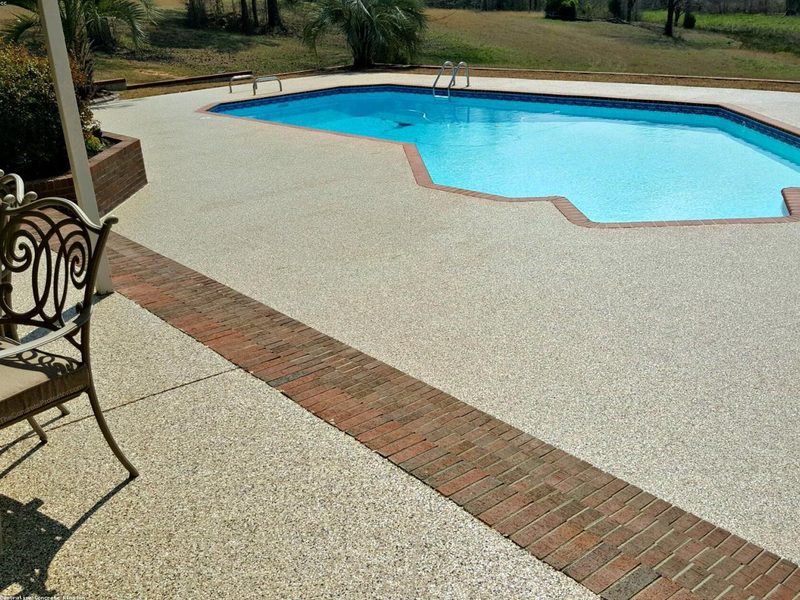
Look closely at the photo. Every speck is a stone that was buried in the concrete until the cement skin over it was washed away. We pour exposed aggregate for patios, driveways, walks and pool surrounds, and we’ll tell you plainly when broom finish is the better buy.

  • Air-Entrained Outdoor Mixes
  • Stone Choice Before the Pour
  • Free On-Site Quotes
Light-colored exposed aggregate concrete surface around an in-ground pool, with a red brick border band

Stock photo showing the finish, not one of our jobs.

What you’re looking at

What Is Exposed Aggregate Concrete?

All concrete is mostly stone. In a normal slab you never see it, because finishing pulls a thin layer of cement paste to the top and that paste becomes the surface. Exposed aggregate is concrete where that top layer is taken off before it hardens, so the stone already in the mix becomes the surface you walk on. Up close, there are four parts to it.

The stone
The coarse aggregate in the mix. Its color, shape and size are the whole look, so it gets chosen before the truck is ordered, not after.
The paste between
Cement and sand locking each stone in place. What’s left of it between the stones decides how well the surface holds up for decades.
The reveal
How far the paste is washed back. The common rule in the trade is no more than about one-third of the stone’s diameter. Go deeper and stones start letting go.
The slab under it
The same reinforced, air-entrained concrete over compacted stone that goes under any slab we pour. The finish is the top fraction of an inch. The rest is ordinary flatwork.
Side by side

Exposed Aggregate vs Broom Finish vs Stamped: Which Surface?

All three are poured concrete over the same base. They split on what happens in the last hour of the job, and that changes how the surface grips, wears, looks and gets fixed.

How the three finishes compare
Question Exposed aggregate Broom finish Stamped
The look Natural stone texture, color from the stone itself Plain gray with fine ridges Pattern and color made to read as slate, brick, cobblestone or wood
Grip when wet Strong, from the stone tops Strong, from the broom ridges Depends on the pattern and on grit in the sealer
Bare feet Pebbly; some love it, some won’t walk on it Comfortable Comfortable, but dark colors run hot
Shovel and plow Blades catch on stone tops; a poly edge helps Easiest to clear Blades catch in deep grout lines
Hides dirt and footprints Best of the three Shows stains and tire marks Good, with color variation
Upkeep Low; sealing is optional and mostly about color Lowest Reseal every 2 to 3 years or the color fades
Fixing a section later Hardest to match Easiest to blend Hard; pattern and color both have to line up
Our published range $8 to $15 per sq ft on patios, the same band as broom $8 to $15 per sq ft on patios $15 to $25 per sq ft
New broom-finish concrete slab along the side of a house, wood forms still in place
Broom finish: the fine ridges are the grip. No stone shows.
Gray stamped concrete patio in a large random-stone pattern beside a house
Stamped: the stone look is a pattern pressed into the surface, covered on our stamped concrete page.

Our honest read: on a patio, exposed aggregate is the best-value upgrade there is, because it costs about what broom does and looks a long way from plain gray. On a driveway it’s a closer call, covered below. And if the slab is for a dining set that has to sit level, chalk drawings, or kids on scooters, pick broom. A stone surface is the wrong answer for those, however good it looks. Patio sizes, layouts and the full cost breakdown are on our concrete patio page.

Free quote

Tell us about your project

Takes about 60 seconds. We’ll get back to you within one business day to schedule a free on-site visit.

Step 1 of 4 What kind of project?
Step 2 of 4 Rough size of the project?
Step 3 of 4 When do you want it done?
Step 4 of 4 Where should we send your quote?
Stone choices

Choosing the Stone: River Rock, Pea Gravel or Crushed Stone

The stone you choose shapes how the finish looks, how it feels and how it ages. These are the choices that matter.

Rounded gravel: river rock and pea gravel

Natural gravel tumbled smooth by water and glaciers. It comes out mixed browns, tans, grays and whites, and it’s what most people picture when they think of exposed aggregate. Rounded tops are the kinder choice under bare feet.

The catch is that natural gravel deposits can carry light, porous particles. The concrete industry’s own guidance names low-density chert in natural gravel as the most common cause of popouts where concrete freezes every winter.

Best for: patios and pool surrounds where people walk barefoot.

Crushed stone

Quarried rock broken into angular pieces. Around Chicago that mostly means gray dolomite, from the bedrock that underlies the whole region. Early Naperville cut limestone for its foundations from the quarry that is now Centennial Beach, worked from 1833 until springs flooded it in 1913.

Angular faces grip harder and look more uniform and modern. Crushed stone is also less likely to contain the porous particles that cause popouts. It is rougher under bare feet.

Best for: driveways and front walks, where shoes outnumber bare feet.

Stone size

Small stone gives a fine, even texture that is easier on feet and furniture. Larger stone looks bolder and more like a riverbed. Size affects durability too: smaller stone builds up less stress when it freezes, so popouts are fewer and smaller when they happen.

The stone has to come from what the ready-mix plant can batch, or be ordered in, and that varies. Settle the actual stone before you sign, and ask to see it exposed, not just loose in a bag.

Rule of thumb: the more bare feet, the smaller and rounder the stone.

You may also hear about seeded aggregate, where decorative stone is scattered over fresh concrete and pressed into the surface instead of coming from the mix. It is a separate technique, used when the stone you want is too costly to put through the whole slab. The finish we describe on this page, and on our patio and pool pages, is the stone in the mix.

How it’s made

How Exposed Aggregate Is Made: Surface Retarder or Brush and Wash

The pour, the screeding and the floating are the same as any slab. The difference is how and when the top paste comes off, and there are two ways to do it.

Surface retarder

  1. The slab is placed, screeded and floated, and the bleed water is allowed to dry off.
  2. A retarder is sprayed evenly over the surface. It slows the set in the top fraction of an inch only, while the concrete underneath cures normally.
  3. Hours later, often the next morning depending on the weather, the softened paste is washed and scrubbed off down to the reveal.
  4. The slab is then water-cured. Curing compound doesn’t go over a retarded surface.

Why most crews use it now: it buys time, so a big slab or a hot day doesn’t rush the wash.

Brush and wash

  1. The slab is placed and floated the same way, with no chemical.
  2. The finisher tests a corner with a stiff nylon broom, waiting for the moment the paste will come off without loosening stone.
  3. The surface is sprayed and broomed section by section until the stone shows evenly.

Where it fits: small slabs. Wash too early and stones come loose. Wait too long and it takes a wire brush to get the paste off.

Either way, the wash is the step that makes or breaks the finish, and it cannot be redone. Patchy spots, stones knocked loose, or a haze of cement left on the stone all come from this one step. Ask who will be doing it and when; the answer tells you a lot about the crew.

Salt, plows and hard freezes

Exposed Aggregate Driveways in Naperville Winters

An average year here brings about 134 nights at or below freezing, and a driveway sees salty slush on most of them. That is the real test of an exposed aggregate driveway, and it mostly comes down to the mix and the first winter.

The mix. Every outdoor mix we pour is air-entrained. The tiny air bubbles give freezing water somewhere to go, and without them any finish scales. For exposed aggregate, the paste between the stones is the part salt attacks, so air content and proper curing matter even more than on a broom slab.

The first winter. Concrete is still drying out and gaining strength through its first season. Deicer meltwater soaking in and freezing is what flakes young paste, so keep deicers off a new slab for its first winter, even one poured in spring. Shovel it and use sand for traction.

Plowing and shoveling. A steel blade riding over stone tops chatters and can chip stones loose over the years. A plastic shovel and a plow service with a poly cutting edge or skid shoes are kinder to it.

Sealing. Exposed aggregate doesn’t have to be sealed. A sealer deepens the stone’s color and slows salt and water getting into the paste. Some owners like the wet look and some don’t. If you seal, it becomes a maintenance job you repeat. Ask us which product makes sense on your stone; a glossy film can make a stone surface slick.

Our honest take: for a lot of Naperville driveways, broom finish is still the right answer. It is the easiest surface to plow and the easiest to blend in if a panel ever has to be replaced. Pick exposed aggregate for a driveway when you want the look and accept that the surface needs a gentler blade. The rest of a driveway job, from tear-out to permits, is on our concrete driveway page.

One Naperville detail: carry the stone finish into the apron between the public sidewalk and the street and the city treats it as decorative, which means a Right-of-Way Encroachment License Agreement filed with the permit. We usually suggest ending the decorative finish at the property line, as our driveway apron page explains.
Wide broom-finish concrete driveway with saw-cut joints leading to a three-car garage on a brick house
A broom-finish driveway. For many driveways, this plain surface is still the one we recommend.
Failure points

Where Exposed Aggregate Concrete Fails

Most exposed aggregate problems come down to the stone or the wash. These are the ones to know about before you choose it.

Popouts

Cause: porous stone near the surface

A small cone-shaped pit where a stone near the surface soaked up water, froze, swelled and broke out, taking a bit of paste with it. Where winters freeze hard and the mix uses natural gravel, a few are an accepted risk. A lower water content, good curing and smaller stone reduce them; nothing fully eliminates them with natural gravel. Most popouts are cosmetic, not structural, but each one leaves a pit that collects water.

Stones that loosen and roll out

Cause: washing too early or too deep

When the paste is washed below about a third of the stone’s depth, or before it has set enough, stones lose their grip. Some come out in the first weeks; others work loose under tires and shovels later. You can’t put the paste back, which is why the reveal depth is a question to ask before the pour.

Patchy or uneven exposure

Cause: uneven retarder, sun, or timing

Retarder sprayed thin in one spot, a corner that set faster in the sun, or a section washed an hour later than the rest. The result is areas where the stone barely shows next to areas where it stands proud. Even spraying, washing the whole slab at the same stage, and keeping downspout water off the slab while it sets are the controls.

Patches that never match

Cause: a stone surface can’t be blended

This is the admission that costs us future work: if a panel of exposed aggregate ever has to be cut out, after a utility dig, a tree root, or a settled corner, the new panel will not match. Different truck, different stone batch, different age. Broom finish blends in within a few seasons. Exposed aggregate shows its patch for good, so plan joints where a future replacement would look intentional.

Rough underfoot and under furniture

Cause: the finish working as designed

The texture that grips wet feet also scrapes knees, rocks chair legs and catches scooter wheels. Around a pool, where people walk barefoot, small rounded stone helps, and a broom-finish band along the coping is another option. Our pool deck page covers the drainage and coping details.

What it costs

What Exposed Aggregate Concrete Costs in Naperville

Patios: broom finish or exposed aggregate

$8 – $15 / sq ft

Same band as broom. Wire-mesh or rebar reinforcement.

Pool surrounds: broom or exposed aggregate

$8 – $15 / sq ft

The grip-first finishes, pitched away from the water.

Driveways fall under our $10 to $20 per square foot installed range, with decorative finish one of the things that moves you within it. Where you land depends on these:

The stone

Whatever stone the plant normally batches costs least. A specific river rock or a special color has to be ordered in.

The wash

A retarder job means the crew comes back to wash, often the next day, plus the retarder itself.

Size and access

Fixed costs spread over more square feet on a big pour. Tight backyards slow every step.

Tear-out

Breaking out and hauling away an old slab adds to any finish.

Borders and mixed finishes

A broom or stamped band around an exposed field means separate pours or more careful forming.

The exact number comes after we’ve walked the site and you’ve picked the stone.

Before you sign

Questions to Ask Before You Sign for Exposed Aggregate

Ask any contractor quoting exposed aggregate these questions, including us. Vague answers here are what lead to the failures above.

  • Which stone, exactly, and can I see it exposed?Natural gravel or crushed, what color, what top size. A sample or a finished slab beats a description.
  • Retarder or brush and wash, and who comes back to wash?If it’s a retarder job, the wash is often the next morning. Make sure an experienced finisher, not whoever is free, is on it.
  • How deep will the reveal go?About a third of the stone’s diameter at most. Deeper looks dramatic for a season and then stones start coming loose.
  • Is the mix air-entrained, and how will it be cured?Air entrainment is what protects the slab from freeze damage. After the wash, a retarded surface gets water curing, not a curing compound.
  • Where will the joints go?Joints control where cracks happen, and they set the lines any future panel replacement will follow.
  • What should I do the first winter?The answer should be no deicers on the new slab, a gentle blade, and sand for traction.
  • Seal or not, and with what?You should hear the pros and cons, and that a glossy film can make stone slick, not just a sealer added to the bill.
Common questions

Exposed Aggregate Concrete FAQ

Is exposed aggregate concrete slippery when wet?

No. The stone tops give it some of the best wet grip of any concrete finish, which is why it is a common choice around pools. The one thing that changes that is a glossy film sealer, which can make a stone surface slick.

Is exposed aggregate a good choice for a driveway in Illinois?

It can be, if the mix is air-entrained, the paste is not washed too deep, and the slab gets no deicers its first winter. It is harder to plow cleanly and harder to match if a panel is replaced later, so for many Naperville driveways broom finish is still the better buy.

Does exposed aggregate cost more than broom finish?

On patios and pool surrounds our published range is the same for both: $8 to $15 per square foot. A special stone that has to be ordered in, the return trip to wash, borders, and tear-out are what move the price.

Does exposed aggregate need to be sealed?

No. Sealing is optional. A sealer deepens the stone color and slows water and salt getting into the paste, but it is upkeep you repeat, and a glossy sealer can make the surface slick.

Can a replaced section of exposed aggregate match the rest?

Not exactly. A new panel comes from a different load of concrete and stone and starts out a different age, so it will show. Plan joints so that any future replacement panel would read as intentional.

Is exposed aggregate comfortable barefoot around a pool?

It depends on the stone and on you. Small, rounded stone is far kinder to feet than large or crushed stone. Some owners love it, others put a broom-finish band along the coping.

Can you expose the aggregate on my existing concrete?

Not as a service we offer. The stone is exposed while new concrete is setting. Blasting hardened concrete can open up stone but tends to fracture and dull it, so if you want the look on an old slab, it means a new pour.

What causes small pits in exposed aggregate?

Usually popouts: a porous stone near the surface absorbs water, freezes, swells, and breaks out. Natural gravel carries more of that risk than crushed stone, and smaller stone keeps popouts fewer and smaller.

Also offered

Other Concrete Services

Want stone showing in your next slab?

Call or fill out the form. Either way, we'll be in touch within one business day.