Skip to content (779) 210-6330 Tap to Call
A homeowner’s guide

Concrete Repair in Naperville: Read the Damage, Then Pick the Fix

Cracked or broken concrete needs one of four things: nothing, a tube of sealant, a specialist, or a saw and a new pour. This guide shows you how to tell which before anyone sells you the wrong one.

Who’s writing: a Naperville flatwork contractor. Our work is pouring new concrete and replacing slabs and sections that have failed, so where a crack doesn’t need us, this page says so.

  • Free On-Site Quotes
  • Written Replacement Numbers
  • No High-Pressure Sales
Diagnose first

Concrete Crack Repair Triage: What Each Crack Means

Concrete repair starts with a diagnosis, not a product. All concrete shrinks as it dries, about a sixteenth of an inch for every ten feet, so every slab cracks somewhere, and saw-cut joints are there to tell it where. The question for any crack is whether it is that shrinkage or a sign that the ground under the slab has moved. Three free tests answer most of it.

  • The shoe testDrag your shoe across the crack. If it catches on a lip, the slab is now two pieces and one of them moved.
  • The pencil testMark both ends of the crack and write the date. Longer or wider next spring means it is still moving.
  • The hose testRun water on the slab and watch where it goes. Water running toward the house or pooling against the slab is behind most of the chart below.
Symptom, cause, fix and who does it
What you see What it usually means What fixes it Who does it
Hairline crack, flat, same width all year Drying shrinkage that missed a joint Nothing. Seal it with a flexible sealant if salt water collecting in it bothers you. You
DIY
Crazing: a fine spiderweb of surface lines Surface paste shrinkage from finishing, rarely deeper than an eighth of an inch Nothing structural. Keep deicers off it. Nobody
Leave it
Joints with the old sealant gone, or weeds growing in them Water has a path down into the base Clean out the joint, add backer rod, run new flexible sealant. You or a caulking specialist
DIY
Popouts: small cone-shaped pits A porous stone near the surface soaked up water, froze and broke out Cosmetic. A patch compound if the pits hold water. You
DIY
Scaling: the top surface flaking off Water and deicer freezing in the pores; worst on slabs poured without air entrainment or finished while wet Stop the salt and protect what’s still sound. Deep scaling across the slab means replacement. You, a resurfacing company, or replacement
Depends
Spalling: chunks breaking off at edges and joints Winter freezing, plow and tire hits, or an edge with nothing solid under it A partial-depth patch if the concrete around it is sound; a new section if it isn’t. Patching or flatwork contractor
Specialist
A crack with one side higher than the other Settlement or heave, not shrinkage: something under the slab moved Find the water first. A piece that dropped whole can be raised; a broken one gets replaced. Slab-raising company or flatwork contractor
Specialist
Wider than about a quarter inch, or longer every spring The base is still moving Fix the cause before the crack. Sealing a moving crack only hides it. Someone who looks under the slab
Specialist
A slab that rises in winter and drops in spring Frost in wet ground, often at a downspout or a garage door Drainage, then a new section on a proper stone base. Filler in the crack does nothing. Flatwork contractor
Replace
A panel broken into pieces at different heights The slab lost its support and has failed Saw-cut it out, rebuild the base, pour it back. Flatwork contractor (what we quote)
Replace

Looking at one particular slab?

The methods

How Each Concrete Repair Method Works, and When It Fails

Short of replacing a whole slab, damaged concrete gets one of four treatments. Each does one job well and fails in one predictable way. Most failed repairs are the right material on the wrong problem.

Flexible sealant for cracks that still move

Use it for
Cracks and joints that open and close with the seasons, which outdoors is most of them, and the gap where a slab meets the house.
How it’s done
The crack is cleaned out and often routed, meaning widened along the top with a grinder so the sealant has a real channel. Joints and wider cracks get a closed-cell foam backer rod, then a polyurethane or silicone sealant. Self-leveling versions are made for flat slabs. The rod keeps the sealant bonded to the two sides only, so it can stretch.
How it fails
Sealant stuck to the bottom of the crack as well can’t stretch, and it tears. It adds no strength, and it wears out, so plan on redoing it. Over a crack that is still widening, it only hides the problem.

Rigid filler or epoxy for cracks that have stopped

Use it for
Dormant cracks: ones your pencil marks say haven’t changed in a year. More often indoors than out.
How it’s done
An epoxy or a cement-based crack filler goes into the cleaned crack and bonds the two sides together. A good epoxy can end up stronger than the concrete around it.
How it fails
In a crack that still moves, rigid material can’t move with it, and the concrete tends to crack again right beside the repair. Outdoors, where a slab freezes over and over every winter, this is the most common wasted repair.

Partial-depth patching for spalls and broken edges

Use it for
A spalled spot, a broken corner or a chipped joint edge, where the concrete underneath is still sound and staying put.
How it’s done
The damaged area is saw-cut around its edges so the patch has square shoulders, chipped out to sound concrete, cleaned, and filled with a repair mortar bonded to the old slab. Any joint that ran through it gets formed back through the patch.
How it fails
Feathered edges, thin where they meet the old surface, flake off the first winter. A patch poured across a joint cracks on the joint line. A patch on a slab that’s moving moves with it. And it won’t match the color.

Saw-cut section replacement

This one is our work.
Use it for
A panel broken into pieces, a section that heaves every winter, a sunken piece that cracked on the way down, or an edge with nothing under it.
How it’s done
Cut along the existing joints so the new piece is a clean rectangle, break out the failed panel, dig out and recompact what’s under it, fix the water that caused it, and pour new concrete back against the slab you keep. Done right, it sits flush and reads as one more panel.
How it fails
If the cause stays, the new panel follows the old one down. And new concrete cures lighter than slab that has weathered for years. Broom finish drifts toward a match over a couple of seasons; an exact match isn’t honest to promise.

Two more options belong to specialist trades, and both come up in the trade list further down. Slab raising pumps grout or foam under a slab that sank in one piece. Resurfacing bonds a thin cement-based topping over a scaled but sound surface. Neither one fixes the ground under the slab.

The decision

Repair or Replace Concrete? Five Decision Rules

A repair buys time on the slab you have. Replacement buys a new slab and a new base. These are the rules we use standing on a slab, and they hold whoever you hire.

  1. The one-third ruleIf more than a third of the panels are cracked or settled, replacement beats patching on cost per year of life. Below that, deal with the bad panels and keep the rest.
  2. Nothing holds over moving groundSealant, patches, toppings and coatings all fail the same way on a slab that is still settling or heaving. Find out whether it’s moving before you pay for any of them.
  3. Fix the water firstA downspout emptying at the slab, a sump line, a yard that drains toward it. Naperville’s own guidance is to let sump water out at least 10 feet from the house. A new section over the same washout fails the same way.
  4. One bad panel doesn’t condemn the slabA single cracked panel in an otherwise good driveway, walk or patio does not justify replacing all of it, even though that’s the bigger job for us. Replace the panel and live with the color difference for a few seasons.
  5. Age countsA driveway is a 25-to-40-year product, not a lifetime one. On a slab original to a house built in the 1970s, a patch buys a season or two, because the base under it is usually the real problem.
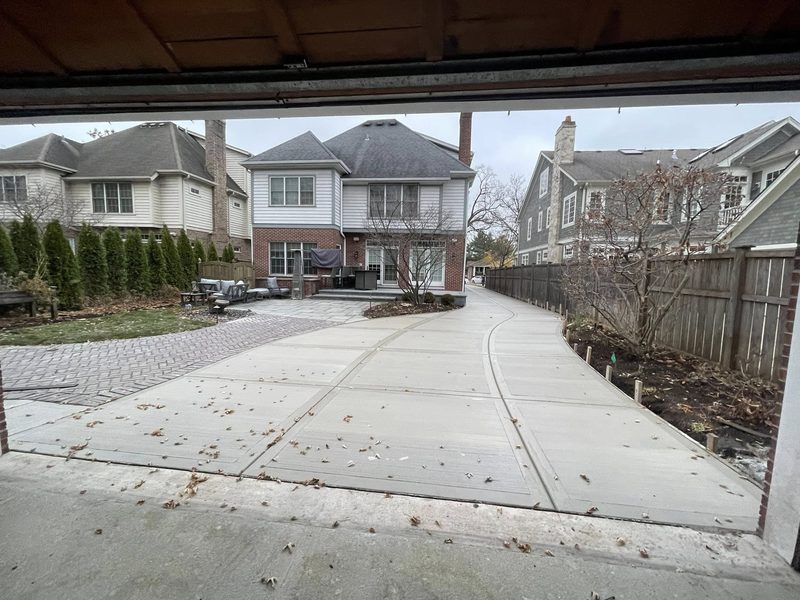
Long broom-finish concrete drive divided into panels by saw-cut joints, seen from inside an open garage
Joints divide a slab into panels. Count the panels that are cracked or settled to apply the one-third rule.
Free on-site look

Not Sure It Needs Replacing? Get a Free Look

Takes about 60 seconds. Tell us what the concrete is doing. We’ll get back to you within one business day to set up a free on-site visit: a written quote if a section or slab needs replacing, and a straight answer if it doesn’t.

Step 1 of 4 What kind of project?
Step 2 of 4 Rough size of the project?
Step 3 of 4 When do you want it done?
Step 4 of 4 Where should we send your quote?
Backyard slabs

Patio Repair: Sunken, Cracked or Sloping Toward the House

Patios fail in their own ways because they sit right against the house, on ground that was dug up and pushed back when the basement went in. These are the four patio problems that come up most.

Sunk next to the house

The soil beside a foundation is backfill, and it keeps settling for decades. A patio poured on it rides it down, the same failure that sinks front stoops. If the slab dropped in one piece and is otherwise sound, a slab-raising company may be able to bring it back up. If it cracked as it sank, that section comes out, the fill gets recompacted, and new concrete goes back.

Sloping toward the house

The one that matters most, because it sends rain at your foundation. A patio should pitch about an eighth of an inch per foot away from the house. One that tips back has settled at the house edge or was poured wrong. No caulk fixes a slope: the slab gets raised if it’s whole, or replaced with the pitch corrected.

Cracked across the middle

Usually shrinkage, or a patio poured with too few joints. Flat and not growing: seal it or leave it. A lip, or a crack that grows: go back to the triage chart. A lot of Naperville yards sit on Drummer silty clay loam, the poorly drained Illinois state soil, and a patio poured on it with no stone base heaves and drops as the moisture underneath changes.

Open gap at the foundation

A patio should butt against the foundation with an isolation joint, never bonded to it, so the two can move separately. That joint is where flexible sealant does the most good, keeping water from running down between slab and wall. Recaulk it when it opens up. A widening gap means the patio is moving away from the house.

When a patio is past saving, replacing it is the same job as pouring a new one. Finishes, layouts and the full price breakdown are on our concrete patio page.

Below the surface

Slab Repair Starts Under the Slab

For any slab on the ground, slab repair means one of two things: putting the slab back where it belongs, or replacing the part that failed. Either way, the concrete is rarely what broke. A slab on grade is only as good as the stone and soil under it, and around Naperville five things go wrong down there.

Wet clay
Much of Naperville sits on tight, slow-draining prairie soils, and in a wet spring the water table can ride within inches of the surface. Clay that swells wet and shrinks dry lifts and drops whatever sits on it.
Frost
An average year here brings about 134 nights at or below freezing. Wet ground under a slab freezes and lifts it; a compacted stone base that drains doesn’t hold the water that heaves. Slabs float on that stone instead of reaching the 42 inch frost depth that DuPage County sets for footings.
Roof water
A downspout emptying beside a slab washes the fine material out from under it, one storm at a time. It’s the first thing to look for at any sunken corner.
Loose fill
Backfill against foundations and over utility trenches was rarely compacted well, and it keeps settling for years. About two thirds of Naperville’s homes were built in the 1970s, 80s and 90s, so a lot of that fill is decades into the process.
Road salt
The City of Naperville has averaged 11,400 tons of road salt a year over the past ten years, and cars carry it home. Salt water in the pores plus freezing is what scales a surface. Keep deicers off new concrete its first winter, and skip ammonium nitrate and ammonium sulfate deicers, which attack concrete chemically.
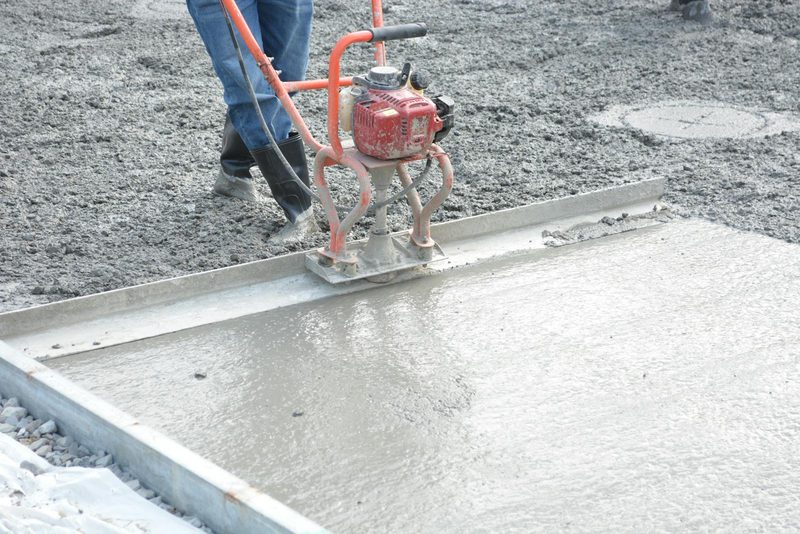
Fresh concrete being struck off with a power screed next to a compacted crushed-stone base
The base is the repair. Compacted stone under new concrete is what keeps a replaced section from following the old one down.

Garage floors are their own case: a slab poured inside the foundation walls, on fill, with salt dripping off the car all winter. Cracks, pitting and sunken sections in garages are covered on our garage floor repair page.

Picking the right trade

Hiring a Concrete Repair Contractor Near You: Who Does What

Search for concrete repair near you and five different trades come back, and each one sees your slab through its own tool. Match the trade to the problem before you call anyone.

Caulking and joint-sealing specialists
Crack and joint sealing with flexible sealants, often a whole driveway or patio in one visit.
Right for: open joints, quiet cracks, the gap at the house.
Wrong for: cracks with a lip, or ones that keep growing.
Slab-raising companies
Mudjacking, which pumps cement grout under the slab, or foam lifting with expanding polyurethane.
Right for: a slab that sank in one piece and isn’t broken.
Wrong for: a slab in pieces, or one whose base is still washing out. Raising a slab doesn’t fix why it sank.
Resurfacing and coating companies
A thin cement-based topping bonded over the old surface, or a coating on top.
Right for: light scaling on a sound, stable slab.
Wrong for: moving cracks, which print straight through the new layer, or a surface that’s still flaking.
Flatwork contractors
Tear-out, base rebuild and new concrete, by the section or the whole slab. This is our trade.
Right for: broken, heaving or widely failed slabs.
Wrong for: a quiet hairline crack. That doesn’t need anyone with a saw.
Foundation contractors
Cracks in basement walls and house foundations, leaks, and structural movement.
Right for: anything in the wall that holds up the house.
Wrong for: patios and driveways. And the reverse holds too: a foundation wall crack is a different trade from flatwork, so call a foundation contractor for it.

What to Ask a Concrete Repair Contractor Before You Hire

  • What’s causing it, and does this fix the cause?A good answer talks about water, base or movement, not just the product.
  • Is this crack still moving, and how do you know?The answer decides between flexible and rigid material, or no repair at all.
  • Which material, and why that one?Flexible sealant for anything that moves. Rigid filler only for cracks that have stopped.
  • What happens at the joints?A patch or topping that bridges a joint will crack along it.
  • Will it match?The honest answer is no, not at first. Be wary of anyone who promises otherwise.
  • What does it need afterward, and how soon will it need it again?Sealants and toppings are maintenance items, not one-time fixes.
  • If it fails, what happens?Get the answer in writing, next to the price.
Doing it yourself

Can You Repair Concrete Cracks Yourself?

Often, yes. A quiet hairline crack or an open joint is homeowner work, and the right answer for it is a tube of flexible concrete sealant from the hardware store, not a contractor. HomeAdvisor’s June 2026 national material prices put concrete caulk at $5 to $10 a bottle. That advice costs us work, and it’s still the right advice.

  1. Pick a dry, mild day. Spring or fall suits most sealants; follow the temperature range on the label.
  2. Clean it out. Wire brush, then a vacuum or compressed air. Old sealant, sand and weeds all come out, because sealant won’t stick to dirt.
  3. Backer rod in joints and wider cracks. Press closed-cell foam rod in first so the sealant grips the sides, not the bottom.
  4. Flexible sealant outdoors. A polyurethane or self-leveling sealant, tooled flush or just below the surface so shovels and plows don’t catch it.
  5. Mark it and watch it. Pencil the ends and the date. If the crack grows, you’ve learned it’s moving, and the sealant was the cheap way to find out.

Where DIY stops: a lip you can trip on, a crack wider than about a quarter inch, a slab that rocks underfoot, or the same crack reopening every spring. Those are about the ground, not the crack.

What it costs

Concrete Repair Cost Compared With Replacement

Crack filling and sealing by a pro

$0.50 – $3 / linear ft

HomeAdvisor, June 2026 national figures, not our prices. Most pros set a $100 to $150 minimum.

Sealing it yourself

$5 – $10 / bottle

HomeAdvisor’s June 2026 national price for concrete caulk. Filler runs $10 to $20.

Replacement is the other end of the scale. By slab, our installed ranges are driveways at $10 to $20 per square foot, walkways and broom-finish patios at $8 to $15, and garage floors at $8 to $14. A single section is quoted on site, because a small pour doesn’t scale down the way people expect: the saw, the haul-off and the concrete delivery cost about the same for one panel as for three.

That’s why the cheapest fix is sometimes the most expensive one. Rigid filler in a moving crack, redone every year, or a patch over a failing base followed by the replacement it was meant to avoid. Weigh any repair quote by cost per year of life, not against zero. What moves a repair price:

Length, not count

Crack work is priced by the linear foot, and a trip minimum covers the first few feet.

The finish

Broom finish is the easiest to patch. Stamped and exposed aggregate surfaces cost more and never fully blend.

The cause

Rerouting a downspout or rebuilding a washed-out base belongs in the number, or the repair won’t last.

Tear-out

Breaking out and hauling away old concrete is a big part of any section replacement.

Raising and resurfacing are priced by those trades. If you’re weighing one, get it in writing next to a replacement quote and compare how long each is likely to last.

Paperwork and property lines

Naperville Permits and Who Owns the Concrete

Small repairs. Naperville’s permit guide says cosmetic improvements don’t need a permit and that a homeowner may do most ordinary repairs without one. We read crack sealing and small patches as falling there. That is our reading, not the city’s wording.

Replacement. That changes once concrete comes out. Naperville requires a permit to reconstruct a driveway, and the city runs stoop and garage floor replacements through its residential Driveway/Sidewalk/Stoop permit. A patio needs one past 500 square feet of paved area, or when gas, electric or a fire feature is involved. On replacement work we pour, the permit is ours to pull and its cost sits inside the quote.

Next door. The rules change at the city line. Wheaton doesn’t require a permit to replace a driveway on a private single-family lot at all, though the apron and public sidewalk still need one. Aurora goes the other way and permits private walks and patios as well.

Whose concrete it is. The public sidewalk in front of your house and the driveway apron out to the street sit on city land, but Naperville makes the homeowner responsible for maintaining them. For sidewalk squares, the city runs a cost-share program for qualifying squares, explained on our walkways and sidewalks page. The apron has its own spec and permit, covered on our driveway apron page.
Common questions

Concrete Repair FAQ

Can cracked concrete be repaired?

Usually, if the crack is the only problem. A crack that is flat and not growing can be sealed, a spalled edge over sound concrete can be patched, and a broken section can be cut out and poured new. What cannot be repaired is concrete over ground that is still moving, or a slab that has failed across more than a third of its panels. That gets replaced.

What is the best way to repair a crack in concrete?

Match the material to the movement. Cracks that open and close with the seasons, which is most outdoor cracks, take a flexible polyurethane or silicone sealant. Only a crack that has stopped moving should get a rigid filler or epoxy, because rigid material in a moving crack lets the concrete crack again beside it.

Should I fill hairline cracks in concrete?

You do not have to. Hairline cracks that stay flat and the same width are drying shrinkage and do not weaken the slab. Sealing them is optional and mostly keeps salt water out. A tube of flexible sealant from the hardware store is the right tool.

When should concrete be replaced instead of repaired?

When more than a third of the panels are cracked or settled, when pieces sit at different heights, when the slab heaves every winter, or when the surface has scaled so deep there is no sound concrete left near the top. Fix the water that caused it too, or the new slab follows the old one.

How much does concrete crack repair cost?

HomeAdvisor’s June 2026 national figures put professional crack filling and sealing at $0.50 to $3 per linear foot, with most pros charging a $100 to $150 minimum. Those are national averages, not our prices. Sealing a quiet crack yourself takes a bottle of concrete caulk, which HomeAdvisor lists at $5 to $10.

Can a sunken patio or walk be raised instead of replaced?

Sometimes. A slab-raising company can pump grout or foam under a slab that sank in one piece and is otherwise sound. It does not fix why the slab sank, and a slab that broke as it sank is a replacement job.

Do I need a permit to repair concrete in Naperville?

Usually not for crack sealing or small patches. The city’s permit guide says a homeowner may do most ordinary repairs without a permit, and we read crack work as falling there. That is our reading, not the city’s wording. Replacing a driveway, stoop or garage floor is different and goes through a city permit.

Will a repair or a new section match my old concrete?

No, not at first. Patch material and new concrete both cure to a different color than concrete that has weathered for years. Broom finish drifts toward a match over a few seasons; stamped and exposed aggregate surfaces never fully blend.

Is a crack in my foundation wall a concrete repair job?

Not for a flatwork contractor. Cracks in basement walls and house foundations belong to foundation repair and waterproofing contractors, a different trade that deals with structure and water in ways patio and driveway work does not.

Slab past saving? Get a replacement quote.

Call or fill out the form. If it needs replacing, you get a written number. If it doesn’t, we’ll tell you that instead.